
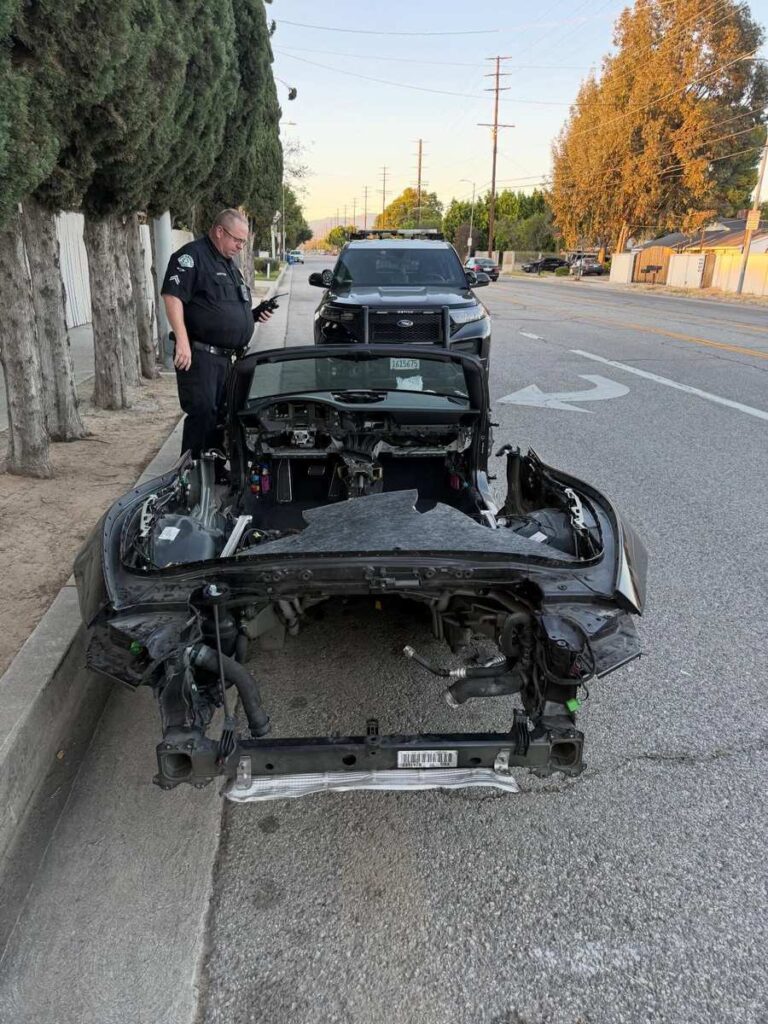
- LAPD Central Traffic Division discovered a 992-generation Porsche 911 Carrera Cabriolet stripped to a bare metal skeleton by a professional theft ring on a Los Angeles street.
- Thieves executed a surgical dismantling of the luxury supercar, removing the flat-six engine, interior, and suspension with Formula 1 pit-crew precision in a matter of hours.
- Black market demand for untraceable components renders the recovered chassis a total financial loss, highlighting a terrifying operational shift toward harvesting parts over exporting vehicles.
The morning sun rose over Los Angeles to reveal a ghost sitting on the asphalt. It wasn’t a spectral figure, but a mechanical carcass—a hollowed-out monolith that once roared with German engineering. To the untrained eye of passing commuters, the metal shell looked like a discarded kit car or a half-finished project abandoned in the night. But to the LAPD officers arriving on the scene, the reality was far more sinister. This was not a case of vandalism or a joyride gone wrong; it was a crime scene left behind by a crew so efficient they picked a six-figure supercar clean before the city even woke up. The incident has sent a chill through the local luxury car community, proving that even the most advanced tracking systems are useless when a vehicle is not driven away, but simply erased piece by piece.
The Anatomy of a Tear-Down
The victim was a Porsche 911 Carrera Cabriolet, specifically a model from the current 992-generation. Identification was nearly impossible at first glance; the thieves had stripped the identity right out of the chassis. Police were only able to confirm the model by examining the specific layout of the pedal assembly and the remaining branded scuff plates on the door sills. This level of obfuscation points directly to a professional car theft ring operating with military-grade logistics. This was not a smash-and-grab; it was a surgical dismantling performed by individuals who knew exactly how to disassemble a modern Porsche without damaging the high-value merchandise.
Everything Must Go
The inventory of missing parts reads like a catalog for a high-end chop shop. The thieves bypassed the exterior and went straight for the heart, removing the flat-six engine and the complex PDK gearbox—components that alone can fetch tens of thousands of dollars on the black market. But they didn’t stop at the drivetrain. The suspension system, wheels, and every single body panel were unbolted and hauled away. The precision continued into the cabin, where the entire interior was gutted. The dashboard, seats, and steering wheel were all extracted, likely destined to repair other 992s that have been in accidents or to upgrade lower-spec models. Even the retractable roof mechanism was harvested, leaving the car as nothing more than a rolling tub.
The Economics of Dismantling
This incident highlights a disturbing shift in automotive crime economics: the sum of the parts is now significantly more valuable—and harder to trace—than the whole vehicle. Exporting a stolen 911 requires forging documents, bypassing port security, and risking GPS detection. However, a completely stripped chassis leaves no digital footprint. By the time the LAPD Central Traffic Division recovery team arrived and the owner was notified, the parts were likely already separated, crated, and on their way to different buyers. While detectives are investigating and a professional operation is suspected, tracing a suspension arm or a seat back to this specific VIN is a forensic nightmare.
A Total Loss
For the owner, the recovery is a recovery in name only. The financial impact is absolute. Insurance adjusters will view the shell not as a car, but as scrap metal. The cost of sourcing every bolt, wire, panel, and mechanical system to restore the vehicle would astronomically exceed the price of buying a brand-new one, making rebuilding financially unfeasible. The parts value exceeds the car value by a wide margin in the underground economy, meaning this theft was likely profitable instantly. The return of the frame serves as a symbolic recovery only—a grim receipt from a transaction the owner never authorized.